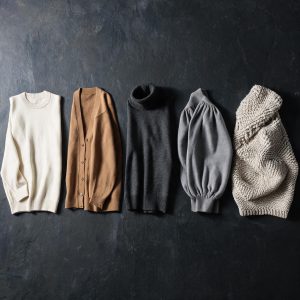
You have 20 designs on paper. Everybody says, “Go big, go professional.” You’re looking at a spreadsheet that shows €8,000 worth of orders possible and €3,000 in your bank account. If you buy everything, you’re going to be out of money. If you just order 5 items, you look like a hobbyist.
There’s something I wish I would’ve known sooner: 3-5 great designs always beat 20 average ones. Your first line is not your message – it’s a test run. There’s a formula for this. Brands that make it through Year 1 are those who stick to a certain ratio.
This is called the 70/30 rule. It’s not a compromise. This is how established brands work every season.
Here’s how it works in terms of your product offering:
70% of core foundations = Core basics (40%) + Core variations (30%).
These include your crewnecks, cardigans, turtlenecks — styles that sell for 3 or more seasons before being tired. They’re not sexy. They don’t get virals. But they pay the bills. In established brands, the core products account for 30%–50% of total sales. Your “boring” oatmeal crewneck is the one paying for your innovative rust-colored piece.
30% of creative bets = Trend pieces (20%) + Wildcard (10%).
They create social media moments. They test new directions. They get the likes. But they’re not responsible for making money, and they shouldn’t be. One wrong trend piece is a lesson learned. But an entire collection of trend pieces that flops is a bankruptcy.
Here’s the first collection planning template I make for each startup I mentor:
| Category | % of Collection | Example Pieces | Order Qty/Style | Purpose |
|---|
| Core basics | 40% | Crewneck sweater, cardigan | 100–200 pcs | Revenue stability |
| Core variations | 30% | Same style, 2–3 colors | 50-100 pcs/color | Test color preference |
| Trend pieces | 20% | Statement sleeve, new silhouette | 50-100 pcs | Social media / buzz |
| Wildcard | 10% | One experimental piece | 50-80 pcs | Test boundaries |
See the numbers. 100-200 units per style. Not 1000. Not 10. It’s 5% more expensive to manufacture 100-piece Minimum Order Quantity compared to buying in large volumes, yet you get to try out 5 styles instead of going all-in with 1 style. Year 1 is about survival, not unit economics. Guaranteed.
Autumn-Winter season is the best time to introduce knitwear in Europe. If you are reading this in spring, it’s time to sample, not to brainstorm and mood board. It’s time to sample because the schedule goes like this:
Design in spring → Manufacture in summer → Market in September
Fail to manufacture in that particular period, and your “autumn collection” will arrive in November when your buyers will buy their winter knits somewhere else.
Currently our knits factory is producing micro batches of 100 pieces. This gives small brands an opportunity.
There’s one more thing to remember about these 20 ideas that you’ve sketched out. I know it may feel like choosing 5 and letting go of 15 of your dreams. It does not. You are clever enough to test them before committing to them. Those 15 will have their turn.
This is not playing small. This is playing to win.