Quality Assurance: 35+ Years of Consistent Quality in Knitwear Manufacturing
In an era where “BSCI certified” and “ISO 9001” appear on every supplier’s brochure, discerning buyers are asking a deeper question: How do we know your quality is consistent year after year?
The answer isn’t found in audit reports. It’s found in history.
Three Machines, Four Decades, One Obsession
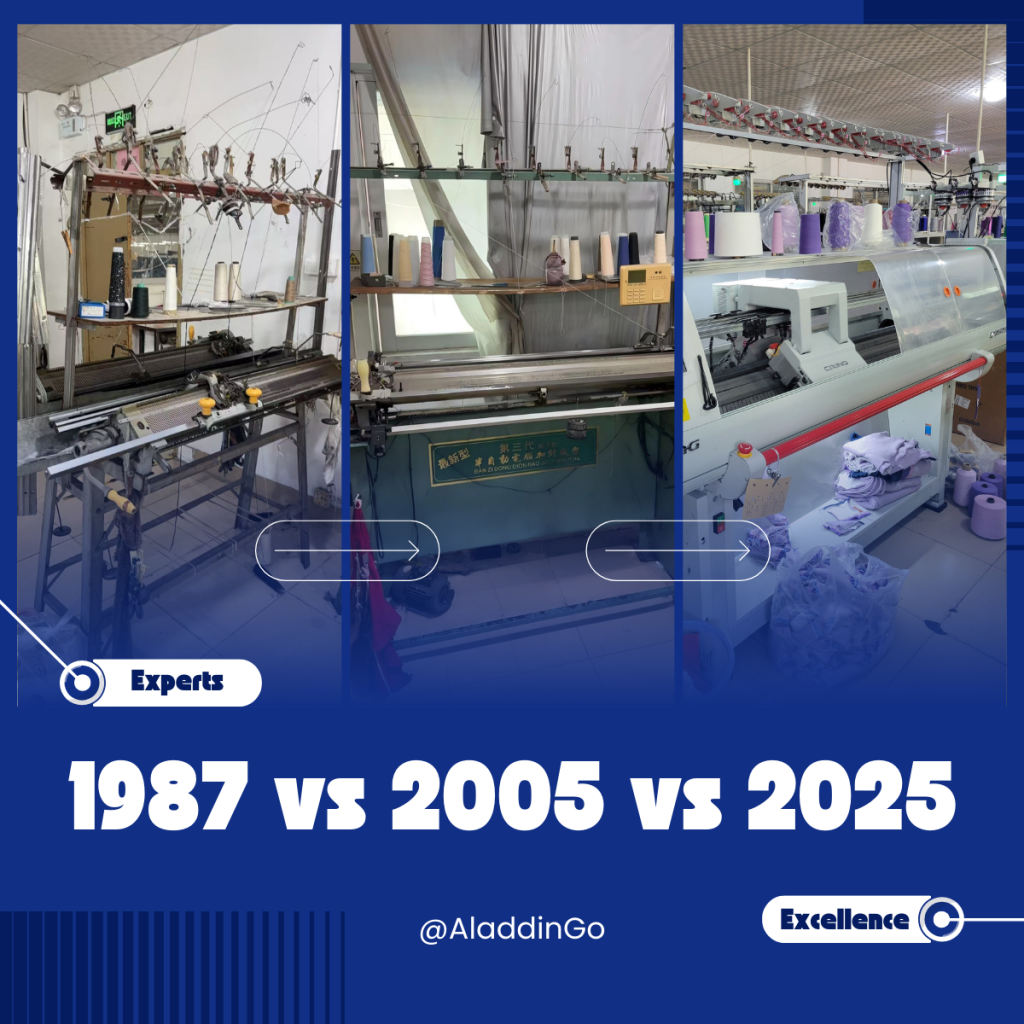
Specifically, walk through our facility in Guangdong, and you’ll see three distinct eras of knitwear technology coexisting—each telling a chapter of our story.
1989-1995: The Foundation (Hand-Operated Precision)
Our journey began with hand-operated flat knitting machines. While primitive by today’s standards, this era established our DNA: master craftsmen who understood that every stitch tension affects the garment’s soul. These machines required human judgment for every row—a skill that demanded patience impossible to replicate in rushed production environments. Subsequently, as market demands evolved, we embraced mechanization.
1995: The Transition (Semi-Automated Agility)
As global demand evolved, we introduced semi-automatic machines. This wasn’t just about speed—it was about consistency at scale. We learned to balance mechanical efficiency with the artisan’s eye, ensuring that increased capacity never compromised the precision our early clients expected. Most recently, we’ve entered the era of intelligent manufacturing.
2025: The Present (Intelligent Manufacturing)
Today, our facility operates fully computerized automated systems—capable of 5-14-gauge knit construction. Yet ironically, the more advanced our technology becomes, the more we value those early lessons in manual craftsmanship. However, one element remains unchanged throughout this evolution.
The constant through all three eras? Our obsession with gauge precision and stitch consistency. While the tools changed, the standard never did.
The Real BSCI Certification: Time
Indeed, while certifications matter, there’s a more compelling proof of quality. New brands often request our compliance certificates. We show them proudly—BSCI, OEKO-TEX, ISO 9001. But then we walk them to a different wall in our sample room.
There, they see repeat order records spanning four decades: 1989 to 2025.
This is the certification that matters most.
Because while a BSCI audit captures a moment in time, 35+ years of repeat orders captures something far more valuable: the trust of brands who’ve risked their reputation on our production floor, season after season, year after year.
“Compliance documents prove you passed a test. Four decades of client retention proves you earned trust.”
Consequently, in the knitwear industry, where a single dropped stitch can ruin a collection and a delayed shipment can kill a launch, longevity is the only metric that truly predicts reliability.
From OEM Legacy to Direct Partnership (1989-2025)
To illustrate this heritage, our manufacturing roots officially trace back to 1989, supplying knitwear to European and Hong Kong trading houses during the region’s manufacturing boom. In 2014, we undertook a strategic restructuring—privatizing operations, achieving full vertical integration, and sharpening our focus on quality-centric production rather than volume competition.
2025 marks a pivotal evolution: The establishment of our Hong Kong company to bridge 35+ years of manufacturing heritage with modern international trade standards.
This isn’t a startup without history. This is a second-generation family operation choosing to open our doors directly to the brands we’ve served indirectly for decades.
As the founder of our 2025 Hong Kong trading arm, I grew up in yarn warehouses and sampling rooms. When European clients ask about quality consistency, I’m not reading from a factory script—I’m pointing to the same machines my father operated, now upgraded but governed by the same rigorous standards.
What This Heritage Means for Your Brand